
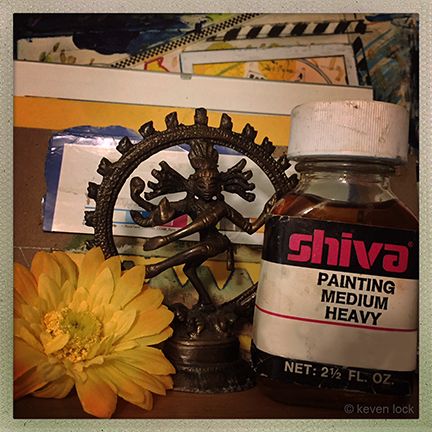
“Spirituality is often a wordless, silent subject and art is a trustworthy passport to this still place.” – Michael A. Franklin – Artist and Teacher, Naropa University
Yogas, the Vedas tell us, are mental, physical, and spiritual practices. They were brought to light thousands of years ago by seers from the ancient Indian subcontinent. Yogas are aimed at achieving a clearer perception of reality and uniting the human spirit with the Divine.
There are many, many different schools and approaches to yoga. The Bhagavad Gita alludes to three: Karma yoga (action), Bhakti yoga (devotion), and Jnana yoga (knowledge).
Reflecting on my own journey of combining my art making and my spiritual practice, I feel the most in common with Jnana yoga. The practice of Jnana yoga seeks the union of the Self (Atman) and Ultimate Reality (Brahman) through knowledge.
My practice encourages me to study and seek inspiration from various visual manifestations of the Divine including yantras (Tantric mystical diagrams) and Tantric paintings, such as the small, exquisite abstracts from Rajasthan.
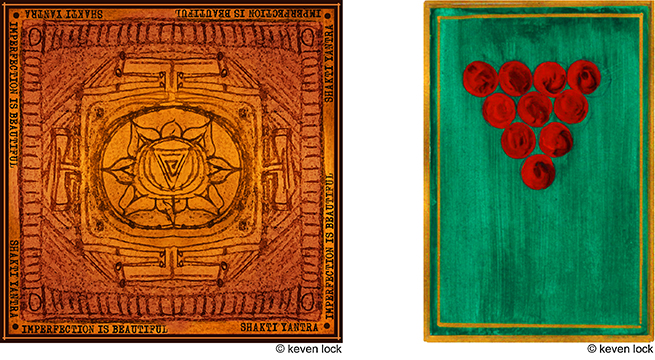
Also, in the Yoga Sutras, the sage Patanjali presents yoga as the suppression of the active mind. For me, this means getting out of my own way to allow myself to create an energetic and unrestrained arena of art making where I experience a liberating alternate consciousness and sense of union.
Since beginning to work in these modes, my experience of art making is more productive, more satisfying and more grounded. It has also led me to evolve a more original and (to me) meaningful vocabulary and has intensified my commitment to my spiritual journey.
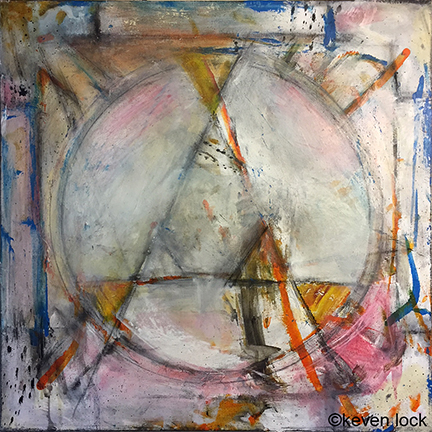
24″ x 24″ Mixed Media on Canvas
Thanks for stopping by! Please post your thoughts!
Kev
 ART, PRACTICE, &
This paragraph…
“Reflecting on my own journey of combining my art making and my spiritual practice, I feel the most in common with Jnana yoga. The practice of Jnana yoga seeks the union of the Self (Atman) and Ultimate Reality (Brahman) through knowledge.”
makes me wonder at a spiritual/mystic/collective unconscious connection between Jnana yoga and the early Christian movement often labeled “gnosticism”. It seems this much-maligned stream in early Christianity was also connecting with the Divine through knowledge.
I think especially of this prayer, titled “The Prayer of Thanksgiving”,
(I’m omitting the verse numbers for ease of reading, but the selection is verses 2-12.)
………
We give thanks to you,
every life and heart stretches toward you,
O name untroubled,
honored with the name of God,
praised with the name of Father.
To everyone and everything
come the kindness of the Father,
and love,
and desire.
And if there is a sweet and simple teaching,
it gifts us mind, word, and knowledge:
mind, that we may understand you;
word, that we may interpret you;
knowledge, that we may know you.
We rejoice and are enlightened by your knowledge.
We rejoice that you have taught us about yourself.
We rejoice that in the body
you have made us divine through your
knowledge.
The thanksgiving of the human who reaches you
is this alone:
that we know you.
We have known you,
O light of mind.
O light of life,
we have known you.
O womb of all that grows,
we have known you.
O womb pregnant with the nature of the Father,
we have known you.
O never-ending endurance of the Father who gives birth,
so we worship your goodness.
One wish we ask:
we wish to be protected in knowledge.
One protection we desire:
that we not stumble in this life.
………
“The Prayer of Thanksgiving” excerpted from – Taussig, Hal (2013). A New New Testament: A Reinvented Bible for the Twenty-first Century Combining Traditional and Newly Discovered Texts. Houghton Mifflin Harcourt. p.8. ISBN 9780547792101.
LikeLiked by 1 person
Awesome! I’m fascinated by this line of thinking and often wonder on the idea of commonality of the origins of the worlds religious traditions.
I had to review and deepen of my understanding of Gnosticism to fully appreciate your great comment. In doing so I learned about Elaine Pagels. Are you familiar with her?? I learned about her through an article entitled Gnosticism: Hinduism’s Alias on a site called Puzzle Peace.
https://ourpuzzlepeace.wordpress.com/2011/06/14/gnosticism-hinduisms-alias/
She’s a religion historian who writes on the Gnostic gospels and is a Professor of Religion at Princeton University.
The article includes these excepts from her book The Gnostic Gospels:
“What we call Eastern and Western religions, and tend to regard as separate streams, were not clearly differentiated 2,000 years ago” (xxi). From reading The Gnostic Gospels, one can make this conclusion: The Gnostic understanding that “to know oneself, at the deepest level, is simultaneously to know God” and other such concepts compare much more closely with Hinduism than any other religion, which, therefore, fabricates the vast chasm that separates Gnosticism from Orthodoxy.”
The article concludes with a discussion of the Gnostic’s unorthodox perception of Jesus and
states:
“The Gnostic belief in Jesus, even this unconventional one, slightly separates Gnosticism from Hinduism, but the separation seems a mere crack in the foundation these two religions sit on in comparison to the canyon between Orthodoxy and Gnosticism.”
Fascinating stuff!
The Prayer Of Thanksgiving is wonderful and interesting. In translating it into my own practice I only stumble over the “Father” Imagery.
Thanks for your very interesting comment!
LikeLike
Buddhism, too 😌
LikeLike
You use the phrase “getting out of my own way” to describe how you manage to ground your work. I recognize this process in my training in the martial arts. There were so many bad habits I had to unlearn, for example, putting myself down for my lack of ability. As time moved forward, I understood more about myself and what drove me. Once I began experiencing what is called “muscle memory” Everything fell into place. I was able to get out of my way, and flow. I had no fear of failure. Because of this, I am now able to stand in front of an audience and have a great time trying to entertain anyone who will put up with me!
Thanks for the blog Keven. It always gets me thinking.
LikeLiked by 1 person
Thanks for continuing to follow and comment! For me to “get out of my own way” is, in part, to stop thinking. I find that a challenge sometimes…
LikeLike
Kevin, I live in Rajasthan! 🙂
LikeLiked by 2 people
I am fascinated to learn this. It is marvelous that you live in such an auspicious place. Do you know much about the tradition of abstract Tantric painting from your home state? I find these paintings very inspiring and I have been considering posting about them. Thank you for continuing to look in!
LikeLike
I have come to know of them through you. Now I will definitely learn more about them whenever I get an opportunity here.
LikeLike
Great writing!
LikeLike
Thank you, Ana!
LikeLike