TRIMURTI

tirthayatra BLOG
TIRTHAYATRA – Mixed Media on Illustration Board – ©2020 keven lock

The Sanskrit word “Trimurti”   त्रिमूर्ति   translates into English as “three forms”.  In Smarti Hinduism, Trimurti is understood to refer to the supreme triple forms of Brahman which  are Brahma, Vishnu, and Shiva.
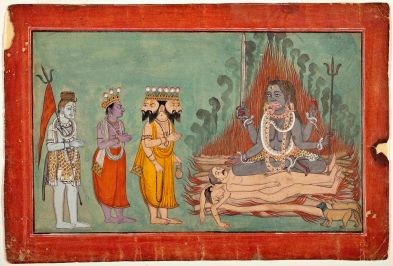
1600px-Shiva,_Vishnu,_and_Brahma_Adoring_Kali,_ca._1740,_Basohli,LACMA
Shiva, Vishnu, and Brahma adoring Kali
Anonymous/Unknown author – Public domain

These three aspects of Brahman are understood to manifest the creation, preservation, and destruction of the universe.
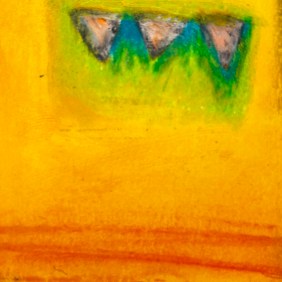
MANIFESTATION - SACRED RIVER
MANIFESTATION/SACRED RIVER
Mixed Media on Paper – ©2019 keven lock

Hindu Shaivites venerate Shiva as supreme and hold the view that Shiva manifests all of the actions of creation, preservation, and destruction.
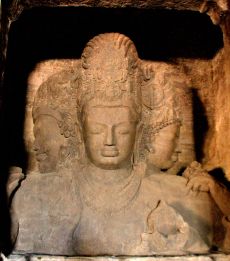
1054px-Elephanta_Caves_Trimurti
Sadashiva
Christian Haugen https://creativecommons.org/licenses/by/2.0

I have found contemplating Vedic concepts of the Trimurti to be rich with inspiration for my own art making.

In his excellent book, American Veda, Author Phillip Goldberg writes that India’s visual arts  have been a minor influence on Western contemporary art as opposed to the huge influence Indian music has had on the Western scene.

Mr Goldberg further reports that Art Historian Debashish Banerji maintains that “it is because Indian painting has mainly been representational” unlike “Western trends toward abstraction and minimalism”.

My own research has shown me that this is quite true. Nonetheless, I’ve been hugely inspired by my Vedantic practice and also by abstract Tantric paintings from Rajasthan. 

“An Egoless Practice”: Tantric Art

On my own path of art making I strive to discover and present imagery in a manner that emulates the oft quoted sentiment of jazz great John Coltrane: “I’d like to point out to people the divine in a musical language that transcends words.”

Screen Shot 2020-02-05 at 10.48.01 PM
OBLATION – Mixed Media on Paper – ©2020 keven lock

Thanks for looking in!
Kev
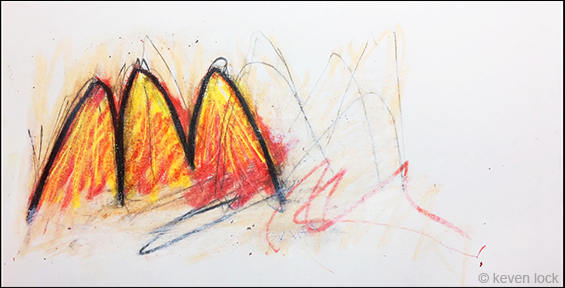
 

Mysticism???

Svaha                 Svāhā (Oblation) – Mixed Media on Paper

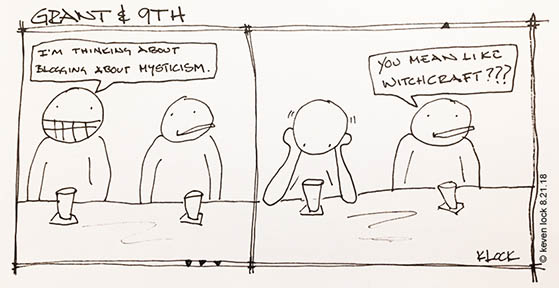
Mysticism??? My best friend called me a mystic just a while back. Wouldn’t it be pretty to think so…

Mysticism is now on the list of things I thought I knew a little something about until I dug  deeper.

“Mysticism,” like “Hindu” and “Religion,” can be a difficult label to get a handle on. Especially if, like me, you are constantly in the position of translating between East and West.

Digging in, I found a great article by an American Catholic priest, Father Thomas Edward Dubay, describing the differences between Hindu, Buddhist, and Christian mysticism. I also read various discussions of the nature of Hindu mysticism, and descriptions of Christian mysticism’s origins, as well as writings decrying mysticism as anti-Christian. From there I moved on to to secular mysticism.

Mysticism Cartoon sized

and from there I moved on to, yup, the occult.

A mare’s nest of multiple ideas! I also found this in an article by the awesome Richard Rohr:

“do not let the word “mystic” scare you off. It simply means one who has moved from mere belief systems or belonging systems to actual inner experience.”

That’s useful.

And, always endeavoring to connect my own spiritual and my artistic dots, I read a fascinating New York Times review from 1986 of a show at the Los Angeles County Museum of Art: “The Spiritual in Art: Abstract Painting 1890-1985’’.  In the review the show’s curator, Maurice Tuchman, is quoted as defining mysticism as the:

“search for the state of oneness with ultimate reality’’

Ok. I’ve been doing that since about the third grade….

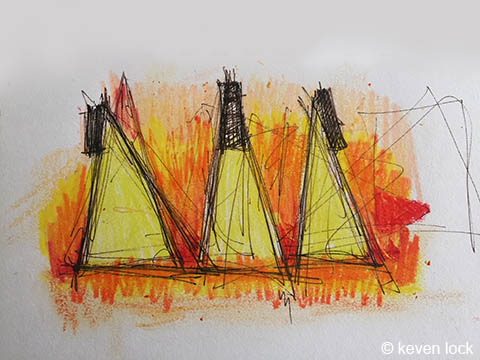
I’m just back from working on a project that took me away from my studio for a month or so and I’ve been finding it challenging to reengage with my art. All I’ve been motivated to draw are the simplest triangles. Today, while drawing and contemplating (another word with a thousand shades of meaning, apparently)  I realized that it’s not so much about what I paint or draw, it’s about how I choose to experience the doing of it. 

Bede Griffiths, aka Swami Dayananda (Benedictine monk and noted yogi), reflecting on mystical experience wrote:

“Anything which breaks through the routine of daily life may be the bearer of this message to the soul.”

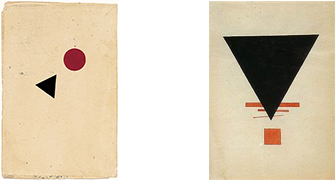
Tantric Triangle plus
Tantric Painting – Anon          Suprematism – Ilya Chashnik
Jaipur, India.                             Russia – 1920

I’m inspired by mystical thinking. I can cop to that. Even while drawing simple triangles. 

Thanks for looking in!
Kev

A thorough discussion of mysticism is way beyond the scope of my blog. The subject deserves and is served by a lot of books! The one I’m currently reading is Mystics – The Soul’s Journey Through Truth by Andrew Harvey. I haven’t finished it yet but it’s looking good so far.
Also, here is a list of the sources I have quoted from above. There are some great ideas here. Take a look at them!
SOURCES:

What’s the Difference between Christian Mysticism, Buddhism and Hinduism?https://catholic-link.org/quotes/whats-the-difference-between-christian-mysticism-buddhism-and-hinduism-quote/ttps://catholic-link.org/quotes/whats-the-difference-between-christian-mysticism-buddhism-and-hinduism-quote/

Mysticism In Religion: Three Ways to View the Sunset   https://www.huffingtonpost.com/fr-richard-rohr/three-ways-to-view-the-su_b_822092.html?ncid=engmodushpmg00000006

ART VIEW; HOW THE SPIRITUAL INFUSED THE ABSTRACT  https://www.nytimes.com/1986/12/21/arts/art-view-how-the-spiritual-infused-the-abstract.html

Moments of Grace: Lifting the Veil  https://yogainternational.com/article/view/moments-of-grace-lifting-the-veil

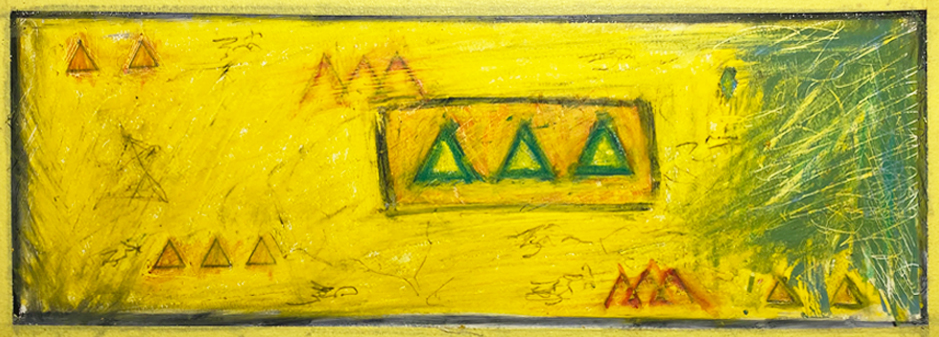
Rishis Sized
Rishis – Mixed Media on Paper