Stop and Smell the Flowers or Explaining Modern Art to my Mom

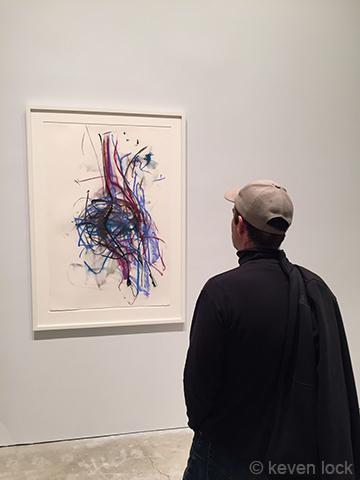
James and Mitchell
James enjoying a Joan Mitchell Pastel Drawing

I love Modern Art.

Motherwell, Dekooning, Mitchell, Newman. Heroes!  They’re my jam!

Do I understand it? Yeah, somewhat. But understanding is not where most of the enjoyment lies for me. I like the attraction I feel to the something unknown. I approach Modern Art in much the same way I try to approach life, by appreciating it while striving to make it less about understanding and more about enjoying the mystery.

Many wonderful works of Western art have dandy literal narratives just waiting to be understood by the viewer, but that’s not the art I’m most drawn to and that’s not the sort of art I make. I love Modern Art (1860ish – 1970ish) and especially Abstract Expressionism and Non-objective Art.  And the art I make is, in part, inspired by Modernism.

But what does all that Modern Art mean?

Pollock supposedly said something about his own work along the lines of:

“It’s like looking at a bed of flowers, you don’t tear your hair out over what it means”.

I’ve always found that sentiment useful.

I get that some viewers are frustrated by Modern Art. To want to understand art is natural and a lot of Modern Art is challenging with that goal in view. To be totally bewildered by some of the art that winds up in museums is quite understandable. Understanding Modern Art (or any art) can take a bit of work.  It takes learning some context.

Newman-Onement_1.jpg
Onement 1, 1948, by Barnett Newman.
Metropolitan Museum of Art – fair use

OR:

Say you’ve just encountered a particularly difficult piece of art on the wall of some world class museum. My invitation is to consider art as the story of humankind’s continuing attempt to explain ourselves to ourselves. In this context, each piece of art might be just a sentence, a word, or even just a letter on a page of that story.  When you encounter a piece of art that you find perplexing or not implicitly beautiful, remember that it still may be important.  Maybe even explore why.

I don’t necessarily try to understand Modern Art myself, I just try to understand my relationship with it.

I don’t attempt to understand God and the universe either, just my relationship with God and the universe.                                  

In my practice, I often reflect on the Nasadiya Sukta.  It’s one of my favorite verses in the Rig Veda (10:129). The last two stanzas as translated by Wendy Doniger O’Flaherty read:

Who really knows? Who will here proclaim it? Whence was it produced?
Whence is this creation? The gods came afterwards, with the creation of
this universe. Who then knows whence it has arisen?

Whence this creation has arisen – perhaps it formed itself, or perhaps it did
not – the one who looks down on it, in the highest heaven, only he knows –
or perhaps he does not know.

It soothingly reminds me to be comfortable with non-understanding.

So, when confronted by some work that seems totally inscrutable, try looking for the mystery in it.  Sink back into that and just float for a while.

Smell the flowers… Count your breaths… Relax……..
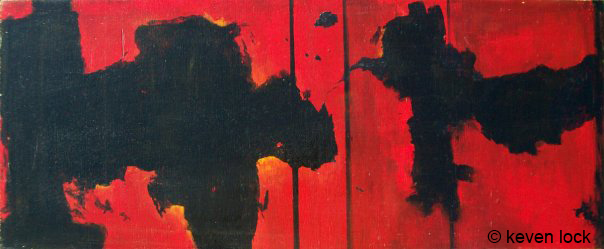
Beast Angel
Beast/Angel – Keven Lock – Acrylic on Wood Panel

Thanks for stopping by!
Kev
Rat-tat-tat-tat-tat-tat or Humble Beginnings

“It took me four years to paint like Raphael, but a lifetime to paint like a child.” – Pablo Picasso

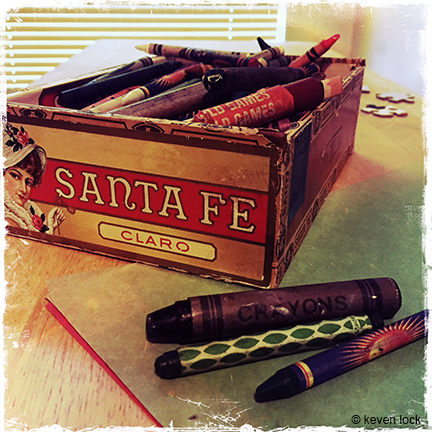
Crayon Box 6x6 x 72 dpi

What are your earliest memories of making art? Mine are from kindergarten. In kindergarten, art time was my favorite time! I liked it even more than milk and cookies and way more than nap time. And crayon, of course, was the medium of the day.

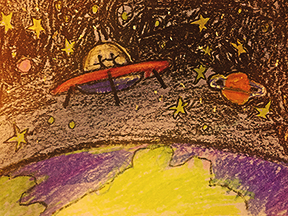
When the slow clock on the wall ticked down to art time, each of our communal tables received a old, beat up, lidless but ornate cardboard cigar box, itself a thing of exotic, golden-edged beauty. Each box was generously stuffed with a jumbled mix of fat and skinny crayons in assorted colors and broken sizes. Thankfully, we were never given anything with a printed outline to color in. We each just got a blank piece of manila paper. During art time we were allowed draw whatever we wanted. Me, and the other boys around me, generally favored spaceships or aerial battle scenes of fighter jets shooting dotted-line streams of destruction at each other. The act of drawing was often accompanied by appropriate sound effects. I’m sad to say that have no memory of what the girls drew. Ladies?

Kid's Space sized

A big part of the fun for me was selecting the next crayon out of the box. So many choices to be pondered over. I always favored the big fat black crayons for coloring in the night sky. And I loved the way the cheap, rough paper took the wax…

I currently live 50 miles from a decent art supply store. And, yes, I could shop online, however, I’m a special-case kind of luddite and I just won’t. But when I run out of my favorite expensive oil pastels, you know what I will do? I’ll happily plunk down $1.95 for a box of 24 crayons at the local grocery store. Joy untold!!! What is more creatively freeing than a medium that’s dirt cheap and that you don’t have to take too seriously?  Want to get your creative juices flowing but are intimidated by expensive art supplies? Get yourself a box of crayons. Daunted by that pristine white sketch pad? Grab yourself a paper bag.

Two Crowns Sized

Actually, there are some real Rembrandts working in crayon these days. You can easily view their beautiful art online. But don’t look just yet. First, take some time to try to remember what and how you drew when you were five. Draw that.  Make some sound effects too. Enjoy!

Thanks for stopping by!

Kev

Homa – Making an offering to a ritual fire.


Met AgnI
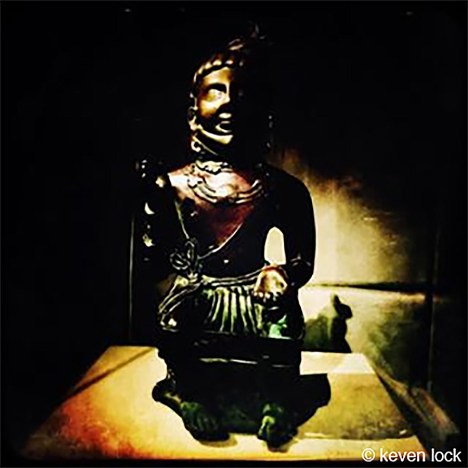
Agni (The God of Fire)  –  Bronze – Metropolitan Museum of Art

Agni – Sanskrit: अग्नि – Vedic deity.  Also: Fire – In ritual and practice, Agni is the messenger who conveys offerings to the Universe. Agni is fire, lightning, and sun. Though of ancient origin, Agni, and his wife Svāhā, are still venerated and invoked at Hindu births, weddings and funerals.

“I adore the Flame, the vicar, the divine Rtvik* of the Sacrifice, the summoner who most founds the ecstasy.” –  Rig Veda 1.1.1 (1st verse of the Hymn to Agni) translation by Sri Aurobindo    

*priest

In my practice, I find it useful, comforting and inspiring to venerate and contemplate Agni.

Two Rishis

                                                             Two Rishis – From my sketchbook

HOMA

Agni,

Oh, mouth of the gods.

Vedic fire.

Triangle of flame.

Receiver. Conveyer. Transformer.

Divine messenger. Divine energy.

Agni, that/who swiftly bears

all to Mahadev.


Three Triangles Sized

                                                             Three Triangles – Oil Pastel on Paper

Thanks for looking in! – Kev

Coordinates of an Unknown Destination or Painting as a Verb

Coordinates For An Unknown Destination

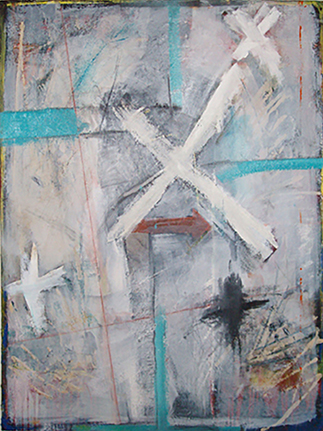
Map Series – Coordinates of an Unknown Destination – 2008 – 48” x 36” – Mixed Media

I consider this to be one of my most “successful” paintings. It was forged in the doing and re-doing of a canvas over a period of a month or so. It started with a finite plan and, in the process of painting, evolved into a wildly different image.

Once I “finished” it  and sat with it long enough to declare it done (or at least permanently abandoned) I shared a pic of the canvas with various friends and unexpectedly received an unusual number of responses.

James, a longtime artist pal, wrote:

“There really is a lot of interesting paint there, excitement, like molecules… what’s the word for air building the electrostatic charge that rips loose as lightning and a      blistering thunderclap?  Brought back a memory from about 8… was mesmerized      looking at a Christmas tree, the amazing rhythm of pine needles in the chaos of          branches, then suddenly aware of the subtle feelings running through me: the              charge of that discovery. Then the distraction – noticed the Christmas decorations –  yanked me out of it. The feeling was gone.

As I was looking at your painting, reliving that strange moment, Hanne leaned in for  a look over my shoulder and asked,

“What are the whites? Something religious?”

“Huh,” I said,  pondering the synchronicity. Said I’d ask. But see what I mean? The mind whispers a response to them.”

“A very powerful and gratifying response,” I thought. “Thanks!”

To my friend’s wife, Hanne, I wrote back that, “what others might see as crosses, I marked as X’s.” They had been cropping up everywhere in my work at the time. Upon reflection, these particular X’s transmogrified in my mind into coordinates in a peculiar geometry/geography radiating in an arc like points on a compass.

Also, I wrote back to Hanne that,  “X’s can denote arrival.  X Marks the Spot.  You Are Here!”

Looking back at that time, I see that I was reading (which is in no way to imply understanding) articles about string theory, particle physics, and speculation about time travel. 

James’ response to the piece startled me. Had I scraped out a glimmer of visual language that vibrated in some universal way?  Something Iconic?  It would be pretty to think so.

I never expect to, but I do get suspicious from time to time.


Optimal Experience

For me, an optimal experience of art making, similar to my experiences with meditation, can be a journey which I embark on primarily to connect to flow, to observe whatever comes up… and to practice ownership of it.

When I pursue this mode of art making, I may or may not start with an idea, a direction, or anything like a specific image in mind. My goal is to create an arena for myself where, through the practice of making art, I can enter what I’ve come to enjoy as a kind of altered reality where I can engage with the directive voice (inner voice? voice of the cosmos?) in a repeating cycle of listening, contemplation, action, contemplation.

It doesn’t always work, but, as in my meditation practice, with more and more repetition, I’ve become able to access the experience more reliably. Often, the resulting art is far less significant to me than the act of creating it. Often, the art is like a postcard from the trip: interesting, but only as a two dimensional memento of a 4th or nth dimensional experience.

At other times, though, I manage to create what I consider to be a more successful image, an image that becomes, for me, an icon or a portal, which, when later contemplated, can connect me back to a flash of that alternate reality. Coordinates of an Unknown Destination succeeds for me in that way.

About Flow: An Autotelic Experience

The following is cherry picked and paraphrased from wikipedia’s article https://en.wikipedia.org/wiki/Flow_(psychology)

Hungarian-American psychologist Mihaly Csiksgentmihalyi and his fellow researchers recognized and named the concept of “flow” around 1975 when Csiksgentmihalyi became fascinated by artists, especially painters, who became completely immersed in their work to the point of foregoing sustenance and sleep.

His use of the descriptor autotelic (from Greek: Auto, meaning self, and Telos meaning goal) rang a tuning fork within me. The article explains an autotelic experience as engaging in “a self-contained activity, one that is done not with the expectation of some future benefit, but simply to experience it as the main goal.”

The article further reports that “Csikszentmihályi suggests that time spent in flow makes our lives more happy and successful.”

And that:

      “People who have experienced flow, describe the following feelings:

       1 – Completely involved in what we are doing – focused, concentrated.

       2 – A sense of ecstasy – of being outside everyday reality.

       3 – Great inner clarity – knowing what needs to be done, and how well we are doing.

       4 – Knowing that the activity is doable – that our skills are adequate to the task.

       5 – A sense of serenity – no worries about oneself, and a feeling of growing beyond                  the boundaries of the ego.

       6 – Timelessness – thoroughly focused on the present, hours seem to pass by the                        minute.

       7 –  Intrinsic motivation – whatever produces flow becomes it own reward.”

                                                                           Small Blog Icon

The above seven point list pretty accurately sums what I experience when I’m creating art in flow.

What is your experience of flow?

Thanks for checking in!

OPENING WITH ONE PAIR or CROSSING THE STREAMS…

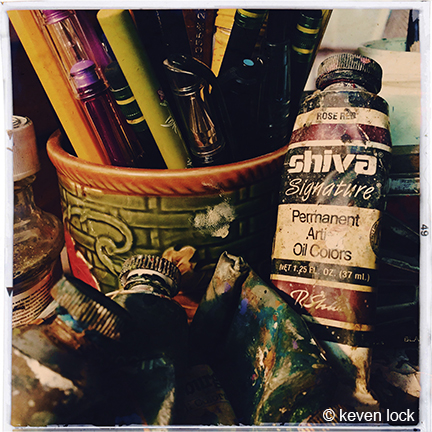
Shiva tube sized

Hello!

Thanks for checking out this inaugural post of ART, PRACTICE, &.

I’m beginning this blog to share thoughts about my personal journey of art making and spiritual exploration.

For readers who are not friends and family, here’s a wee bit about me:  

Professionally, I have enjoyed a 40 year career working as a designer and scenic artist for theater, film, and network television. I spent twenty of those years living and working in NYC.

Personally, I have been making art, music, and theater, writing, and exploring Eastern spiritual practices since my early teens.

Currently, I reside amidst the tall trees of the Pacific Northwest, where I continue to follow my creative pursuits, and teach and design, as opportunities present themselves.

Spiritually, I identify as Hindu and I’m a Pastor Spouse to a truly wonderful woman who is a United Methodist Minister.

Oh, and we have a really, really old black cat named Coyote…

And what about that weird title up there, ART, PRACTICE, &? Well, though I’m starting this blog primarily to write about connecting my art making and my spiritual practice, I’m sure I’ll meander down other paths as well. I tend to lean toward quirky thought, extravagant punctuation, and I’ve always liked ampersands… and e. e. cummings…

Now, down to the business at hand!

Stream One:

Making art is what I’ve been pulled to do ever since I was a youngster. Crayons in kindergarten and grade school, coloring books, drawing spaceships and the planets; I did the usual stuff. I had an older sister who did art with crayons too, only she melted them over a candle and made colorful drippy Pollocks on pieces of wood. I was fascinated!

In junior high, I graduated to colored pencils and drawing mod designs, peace signs, strutting heroes, and otherworldly landscapes emulating my favorite sci-fi paperback and album covers.

Peter Max, Rodger Dean, Frank Frazetta. Conan. Yes and Cream.

Then:

I spent one particularly sunny summer afternoon at the county library, squatting between the stacks, leafing curiously through a book on modern art. Its pages were filled with literally stunning images of Braques, Klines, Rothkos, and the like. I was agog with wonder! This was a new world! And in that book, on that day, I discovered a Motherwell reproduction that spoke right to the core of my young self in a language which I clearly perceived, but couldn’t at all comprehend.

It scared me a little bit and mystified me a lot. It stuck with me. It got to me. It stirred something.

I now count that moment as my third ever spiritual experience…

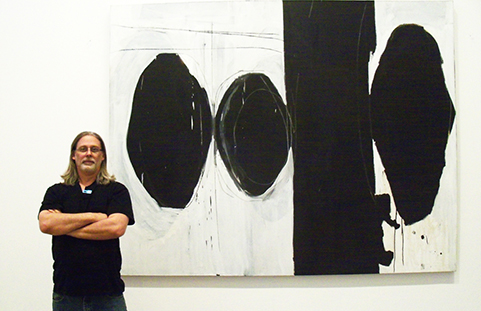
Kev and Motherwell - Elegy to the Spanish Republic - 1958-60 - Philly

Standing with Elegy to the Spanish Republic – Robert Motherwell – 1958-1960 – Philadelphia Museum of Art

Stream Two:

Along about that same time, I chanced to purchase a book on Eastern thought and practice from the remainder bin at the local Kmart.

Now, my mother was a Polish Catholic converted to Protestantism, and my Dad was a baptized-in-the-creek Kentucky Christian. They took me along to church when I was a kid in elementary school, but didn’t make any particular effort pass their faith on to me. I was never baptized into a Christian church, and I didn’t turn that way when, in my adolescence, I began to feel the beginnings of a spiritual void. It was the early 70’s and there were influences of all kinds around me. I had a brother-in-law I idolized who practiced transcendental meditation, my high school art teacher was an Eckankar devotee, and, of course, there were the Beatles, Pandit Ravi Shankar, and protesting the war in Asia.

I was a stripling hippy wrapped in incense and Indian-print bedspreads. Eastern philosophy? I was in!

No surprises there.

Crossing The Streams:

By the end of high school, the thought of trying to feed myself by making pure art was just too daunting. I had been designing and building and painting stage sets all through high school and loved it. I reasoned that I might just be able to make a career out of that. (Only marginally more realistic, right?)

Luckily, it worked out. I studied Art and Theater in college, learned to render, kept making art for myself and began to hear – and learned to heed – the hum of an inner voice guiding my creative endeavors.

It took me years to realize that the inner voice I learned to listen to when making art sounded just like the inner voice I heard when meditating….

It took me more years, and the encouragement of my partner, to begin to understand the non-duality,

…Atman is Brahman…

and to understand that, for me, freeing my creative self IS spiritual practice. The more I’ve merged those two streams in my life, the more clarity, purpose, direction, and joy I’ve experienced.

I was doing it before I knew it. I want to celebrate that I’m beginning to know it now.